


Hello, this is Sungmo Best Internal Medicine in Siheung. Many people set health management as a goal for the new year. However, when caught up in busy daily life, taking care of one's own body often gets pushed aside. In the meantime, many people go about their lives without objectively knowing their health status, missing the right time for necessary management.
It is never simple to restore health once it has deteriorated. So today, we have organized the reasons why you should receive a comprehensive health check-up at a Siheung check-up center, and the out-of-pocket costs that many people are curious about, in a Q&A format.

Why a Check-up is Needed Now
Abdominal pain, indigestion, shoulder stiffness, chronic fatigue. These are symptoms that many modern people experience. The problem is the attitude of dismissing these symptoms as "something everyone experiences." Even common-looking symptoms can be early signs of various diseases.
- As you age, weaker areas may gradually worsen.
- Major diseases can be managed much more easily if discovered early through regular check-ups.
- It is more accurate to confirm the body's warning signs through examination, not just by feeling them.
Checking your health status before it's too late and taking quick action if needed is why regular check-ups are important.

Q. How much is the out-of-pocket cost for a comprehensive health check-up?
To get straight to the point, there is no out-of-pocket cost for the general health check-up recommended by the government once every two years.
| Category | Out-of-Pocket Cost |
|---|---|
| National General Health Check-up (once every 2 years) | None |
| Additional optional items such as cancer screenings, ultrasounds | May incur costs depending on the item |
Some people postpone examinations due to cost concerns, but if you only receive the basic items, a check-up is possible without worrying about expenses. On the contrary, if a disease progresses due to delayed check-ups, the cost of treatment can be much higher, so it is better to prioritize regular check-ups even from an economic perspective.

Q. Which items should I choose?
The items for the National General Health Check-up are fixed, so you can receive them as they are. The area that requires consideration is additional tests. It is good to configure the items according to your body condition and concerns, and at this time, consultation with the check-up center comes first.
In particular, as cancer is considered one of the leading causes of death worldwide, tests that can detect related risks early are helpful. A representative test is a colonoscopy. It can detect polyps and early-stage cancer in the colon, which is advantageous for prevention and early treatment. In the past, it was mostly recommended for those aged 50 and above, but with changes in lifestyle and eating habits, regular examinations are now recommended from age 35 and above. The recommended frequency may vary by individual, so you can determine it through consultation. You can check the procedures for check-ups and endoscopies in advance in the Examination Guide.
If you want to receive a specific test but the facility does not have the equipment, requiring you to visit another institution, it can be inconvenient. Choosing a check-up center that can perform a wide range of examinations is also an important point.

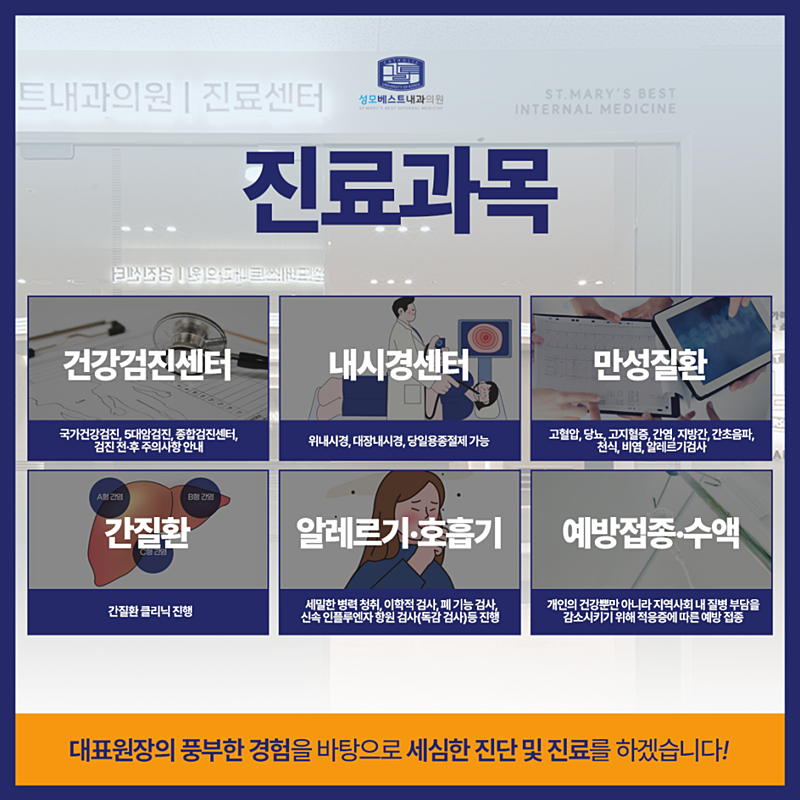
From Check-up to Consultation and Treatment, All in One Place
After receiving a diagnosis, we recommend finding a place where you can continue to receive consultation on the results and necessary treatment. It is much more convenient if you can receive care within a systematic process without having to move between different institutions.
Being young is no reason to be complacent. Please remember that consistent health management is necessary for everyone, regardless of age or gender. You can check the schedule before your visit in the Clinic Hours Guide.

If you have questions about check-up costs or items, please inquire via chat
Dr. Kim Seonhoo (Specialist in Gastroenterology, Specialist in Gastrointestinal Endoscopy) · Medical Staff Introduction · Last reviewed 2026-08-06